


Kevin Brousseau

Coordonnateur de la langue crie, Grand Conseil des Cris du Québec
Kevin Brousseau s’intéresse à la dialectologie et la lexicographie des dialectes du CINA (Cri-Innu-Naskapi-Atikamekw).
Publications
Livres
Brousseau, Kevin. 2013. Trilingual Lexicon of the Fauna and Flora of James Bay, 2nd edition, Aanischaaukamikw Cree Cultural Institute, Oujé-Bougoumou, Québec
Articles/ chapitres de livres
Brousseau, Kevin. 2011. « La lexicographie des dialectes cris, innus, naskapis, et atikamekws au Québec». In L. Drapeau (dir.) Les langues autochtones du Québec : Un patrimoine en danger. Presses Universitaires du Québec : Québec.
Brousseau, Kevin et John. E. Bishop. 2011. «The End of the Jesuit Lexicographic Tradition in Nêhirawewin Bishop», Historiographia Linguistica, 38:3, pp. 293-324
Thèse/mémoire
Brousseau, Kevin. 2009. « Les médianes en Nehirawewin, dialecte historique du Cri-Montagnais-Naskapi » Mémoire. Montréal (Québec, Canada), Université du Québec à Montréal , Maîtrise en linguistique.
Conférences
Brousseau, Kevin et John. E. Bishop. 2011. I Speak Cree, Not Innu: Ethnically United, Ethnonymically Divided, Vivre au Québec: ethnicité, race et genre du 19ème au 21ème siècle, Montreal, Québec, 28 avril.
Brousseau, Kevin et John. E. Bishop. 2009. Jean-Baptist de la Brosse at Work : The Compilation of the Radicum Montanarum Silva (ca. 1776-1775), 41st Algonquian Conference, Montreal, Québec, du 29 octobre au 1 novembre.
Renée Lambert-Brétière

Professeure, University of Maryland, Baltimore County
This email address is being protected from spambots. You need JavaScript enabled to view it.">This email address is being protected from spambots. You need JavaScript enabled to view it.
Renée Lambert-Brétière s'intéresse particulièrement (mais pas uniquement) aux effets sémantiques et pragmatiques sur la structure morphosyntaxique dans trois langues typologiquement distinctes, soit l'innu, le kwoma (Papouasie Nouvelle-Guinée) et le fon (Bénin). De manière plus globale, ses recherches s'inscrivent à l'intérieur du paradigme de recherche de documentation linguistique qui vise l’archivage à long terme de la langue et de la culture d’une communauté.
Publications
Livres
Renée Lambert-Brétière. 2010. Les constructions sérielles en fon: approche typologique. Louvain & Paris: Peeters.
Floricic, Franck et Renée Lambert-Brétière. Eds. 2010. La négation et les énoncés non susceptibles d’être niés. Paris: Éditions du CNRS.
Articles
Drapeau, Lynn et Renée Lambert-Brétière. 2016. "Insubordination in Innu." In J. Randolph Valentine & Monica Macaulay (éds.), Actes du 44e Congrès des Algonquinistes. New York : SUNY Press.
Lambert-Brétière, Renée et Claire Lefebvre. 2015. “Relabelling in Two Different Theories of the Lexicon.” In Claire Lefebvre, Relabelling in Language Genesis. Chapitre 4, pp. 103-138. Oxford: Oxford University Press.
Lefebvre, Claire et Renée Lambert-Brétière. 2015. "Relabelling and Word Order: A Construction Grammar Perspective.” In Claire Lefebvre, Relabelling in Language Genesis. Chapitre 5, pp. 139-163. Oxford: Oxford University Press.
Lambert-Brétière, Renée et Claire Lefebvre. 2014. « A Note on the Haitian Double-Object Construction and the Relabelling-based Account of Creole Genesis». Journal of Pidgin and Creole Languages, Vol. 29, No. 1, pp. 143-156.
Lambert-Brétière, Renée. 2013. « Ethical dilemmas in documenting the Kwoma language». In N. Ostler & M. J. Norris (éds.), Proceedings of the Seventeenth Conference of the Foundation for Endangered Languages (FEL). Université Carleton, Ottawa, Canada, pp. 178-183.
Drapeau, Lynn et Renée Lambert-Brétière. 2013. «The Innu Language Documentation Project». In N. Ostler & M. J. Norris (éds.), Proceedings of the Seventeenth Conference of the Foundation for Endangered Languages (FEL). Carleton University, Ottawa, Canada, pp. 191-192.
Lambert-Brétière, Renée et Lynn Drapeau. 2011. « Verbal Classifiers in Innu ». Anthropological Linguistics, Vol. 53, No. 4, pp. 293-322.
Lambert-Brétière, Renée. 2011. « La documentation linguistique au service de la préservation et conservation des langues autochtones du Québec ». In Lynn Drapeau. Ed. Les langues autochtones du Québec: un patrimoine en danger, pp. 195-218. Sainte-Foy: Presses de l’Université du Québec. Anthropological Linguistics, Vol. 53, No. 4, pp. 293-322.
Lambert-Brétière, Renée. 2010. « L’expression de la séquentialité en fon ». In Essais de Linguistique Générale et de Typologie Linguistique offerts à Denis Creissels, F. Floricic (éd.), pp. 167-186. Paris: Presses de l’École Normale Supérieure.
Floricic, Frank et Renée Lambert-Brétière. 2010. "Introduction." In La négation et les énoncés non susceptibles d’être niés, (eds), pp. 1-4. Paris: Éditions du CNRS. (avec Frank Floricic)
Lambert-Brétière, Renée. 2010. "Séries verbales: le critère de la négation revisité". In La négation et les énoncés non susceptibles d’être niés, F. Floricic & R. Lambert-Brétière (éds.), pp. 211-223. Paris: Éditions du CNRS.
Lambert-Brétière, Renée. 2009. "Serializing languages as satellite-framed: the case of Fon", Annual Review of Cognitive Linguistics, Vol. 7, pp. 1-29.
Lambert-Brétière, Renée. 2009. "Faut-il reconnaître une classe d’adjectifs en fon?", Faits de langues : les cahiers, Vol. 1, pp. 205-228.
Lambert-Brétière, Renée. 2006. "Les constructions sérielles en sɔ́ en fon et la grammaire constructionnelle". In Constructions verbales et production de sens, K. Ploog & C. Paulin (eds), pp. 87-98. Besançon: Presses Universitaires de Franche-Comté.
Lambert-Brétière, Renée. 2004. 'Diminutive Reduplication in Government Phonology", Revista de Estudos da Linguagem [The Journal of Language Studies], Vol. 12, No. 1, pp. 89-113.
Conférences
Lambert-Brétière, Renée. 2016. Endangered Languages of the World, Mother Language Internation Day Celebration, University of Maryland, Baltimore County, 26 février 2016.
Lambert-Brétière, Renée. 2016. Serial verb constructions in Caribbean Creoles. Society for Pidgin and Creole Linguistics Conference, Washington DC, United States, 8-9 janvier 2016.
Lambert-Brétière, Renée. 2015. Language Competence in the Field, and the Challenges of Documenting the Kwoma Language (Papua New Guinea), MLLI Faculty and Student Annual Research Day, University of Maryland, Baltimore County, 6 novembre 2015.
Drapeau, Lynn, Renée Lambert-Brétière, Yvette Mollen et Hélène St-Onge. 2015. Non-standard transcription of Innu: an essential ingredient of its documentation. The 4th International Conference on Language Documentation and Conservation (ICLDC), “Enriching Theory, Practice, & Application,” University of Hawai, Honolulu, 26 février-1 mars 2015.
Lambert-Brétière, Renée. 2014. Comitative constructions in Fon. Syntax of the World Languages 6, University of Pavia, Pavia, Italie, 8-10 septembre.
Lambert-Brétière, Renée et Lynn Drapeau. 2013. Making the most out of the past: Retrieving and archiving old records of the Innu language. Research, records and responsibility (RRR): Ten years of the Pacific and Regional Archive for Digital Sources in Endangered Cultures (PARADISEC), University of Melbourne, Australie, 2-3 décembre.
Lambert-Brétière, Renée. 2013. Variation and change in conjunct third-person plural marking in Innu. 45e Congrès des Algonquinistes, Université d’Ottawa, 18-19 octobre.
Lambert-Brétière, Renée. 2013. Ethical dilemmas in documenting the Kwoma language. Endangered Languages Beyond Boundaries: Community Connections, Collaborative Approaches, and Cross-Disciplinary Research, Université Carleton, Ottawa, 1-4 octobre.
Drapeau, Lynn & Renée Lambert-Brétière. 2013. The Innu language documentation project. Endangered Languages Beyond Boundaries: Community Connections, Collaborative Approaches, and Cross-Disciplinary Research, Université Carleton, Ottawa, 1-4 octobre.
Lambert-Brétière, Renée. 2013. Use of the Innu corpus to understand variation in third-person plural marking. Changement et variation au Canada (CVC) 7, Université de Toronto, 4-5 mai.
Lambert-Brétière, Renée et Lynn Drapeau. 2012. The rise of clause chaining in Innu. 44e Congrès des Algonquinistes, Gleacher Center, University of Chicago, 25-28 octobre.
Lambert-Brétière, Renée. 2012. Clause Linking Devices in Kwoma. Syntax of the World’s Languages 5, University of Zagreb, Dubrovnik, Croatia, 1-4 octobre.
Lambert-Brétière, Renée et Lynn Drapeau. 2012. From preverbs to sequence markers: clause chaining in Innu, Syntax of the World Languages 5, University of Zagreb, Dubrovnik, Croatie, 1-4 octobre.
Lambert-Brétière, Renée et Claire Lefebvre. 2012. Relabelling in two different theories of the lexicon. Society for Pidgin and Creole Linguistics Conference, Portland, Oregon, États-Unis, 6-7 janvier.
Lambert-Brétière, Renée et Claire Lefebvre. 2012. A Construction Grammar perspective on how word order is established in creole genesis. Society for Pidgin and Creole Linguistics Conference, Portland, Oregon, États- Unis, 6-7 janvier.
Lambert-Brétière, Renée et Lynn Drapeau. 2011. Le conjonctif en innu : un cas d’insubordination, 4ème Colloque International de l'Association Française de Linguistique Cognitive, Laboratoire Dynamique du langage, Lyon, 24-27 mai.
Lambert-Brétière, Renée et Claire Lefebvre. 2011. Serial verb constructions in Caribbean Creoles: A relabelling account within the framework of Construction Grammar, 4ème Colloque International de l'Association Française de Linguistique Cognitive, Laboratoire Dynamique du langage, Lyon, 24-27 mai.
Lambert-Brétière, Renée et Lynn Drapeau. 2011. Innu verbal classifiers: Classifiers or incorporated nouns? 14th Annual Workshop on American Indigenous Languages (WAIL), University of California, Santa Barbara, États-Unis, 15-16 avril.
Lambert-Brétière, Renée et Lynn Drapeau. 2010. Verbal classifiers in Innu, 9th High Desert Linguistics Society Conference (HDLS-9), University of New Mexico, Albuquerque, États-Unis, 4-6 novembre.
Lambert-Brétière, Renée. 2010. Discourse-based transitivity in Kwoma, Syntax of the World Languages 4, Université Lumière Lyon 2, France, 23-26 septembre.
Lambert-Brétière, Renée. 2008. The grammaticalization of the verb wo 'to say' in Kwoma, 2nd Sydney Papuanists' Workshop, University of Sydney, Australie, 28-29 juin.
Lambert-Brétière, Renée. 2006. Constructional constraints in Take serial verb constructions in Fon, 37th Annual Conference on African Linguistics, University of Oregon, Eugene, États-Unis, 6-9 avril..
Lambert-Brétière, Renée. 2006. Culturally-driven sequential serializations in Fon, Leipzig Students’ Conference in Linguistics, Max Planck Institute for Evolutionary Anthropology, Leipzig, Allemagne, 26-27 mars.
Lambert-Brétière, Renée. 2006. Les constructions sérielles en prendre et la grammaire constructionnelle, Colloquium “Constructions verbales et production de sens”, Université de Franche-Comté, Besançon, France, 26-28 janvier.
Lambert-Brétière, Renée. 2004. Séries verbales : le critère de la négation revisité, 4e Colloque “Typologie des langues et universaux linguistiques” (TYPO 4), Maison des Universités, Paris, France, 15-16 novembre.
Lambert-Brétière, Renée. 2004. Le phénomène de ‘factativité’ en fon, Sur la route du verbe, Colloque Jeunes Chercheurs en Sciences du Langage, Université des Lettres et Sciences Humaines, Nancy, France, 30 septembre - 1-2 octobre.
Lambert-Brétière, Renée. 2003. On the two 'Takes' in complex SVCs, 5ième Colloque de Syntaxe et Sémantique à Paris (CSSP 03), Université de Paris 7, France, 2-4 octobre..
Lambert-Brétière, Renée. 2003. Le sémantisme grammatical du verbe prendre dans les constructions sérielles en fon, Représentation du sens linguistique II, Université du Québec à Montréal, Canada, 23-25 mai. .
Fanny York
Doctorante en linguistique, Université du Québec à Montréal.
Conférences
York, Fanny. 2013.The discovery of the direct-inverse system in Algonquian languages, Henry Sweets Annual Colloquium, Berlin, Allemagne, 28-31 août.
York, Fanny. 2013. Posture verbs in Innu, International Congress in Cognitive Linguistics (ICLC), Edmonton, Canada, 23-28 juin.
York, Fanny. 2012. La grammaire du cri de Joseph Howse ou comment analyser une langue polysynthétique au 19ème siècle, 80e congrès de l’ACFAS, Montréal, Canada, 7-11 mai.
York, Fanny. 2011. La sémantique des verbes de mouvement en innu, 4ème colloque International de l'Association Française de Linguistique Cognitive (AFLiCo), Lyon, France, 24-27 mai.
Thèse/mémoire
York, Fanny. 2010. La sémantique des verbes de mouvement en innu, mémoire de maîtrise, Département de linguistique, Université du Québec à Montréal.
The Innu language
THE INNU LANGUAGE
Innu belongs to the Central branch of the Algonquian language family; it is part of the great dialect complex (a sequence of dialects) known as Cree and is spoken from Labrador to Alberta, Canada.
Typological profile
A TYPOLOGICALLY-based classification primarily aims to identify a language’s membership to a group of languages, based on similarities of internal linguistic organization. From this point of view, Innu is a POLYSYNTHETIC language, and from the point of view of constituent marking, it belongs to the so-called “head-marking” languages.
Polysynthetic languages are mostly found in North America (Algonquian, Iroquoian, Wakashan, Salish, Sioux, Athapascan, Inuktitut and other Eskimo dialects, Nahuatl, etc.), in Siberia (Chukchi, Nivkh, Ket, etc.) and in the South Sea Islands (Yimas, Lenakel, etc.). They are also found in South America, in Australia and in the Caucasus. Polysynthetic languages present a group of common structural features, the most striking being the presence of complex verbs which would constitute complete sentences in other languages. For example, in Innu, the verb tshikakunishkueuneshinu means ‘He’s lying down with his hat’. Reference can be found to the subject ‘he’ (final -u), to ‘his hat’ (akunishkueun), to the fact that he is wearing it (tshik-) and finally, to the fact that the subject is lying down (-shin-) rather than standing or sitting. This English sentence is therefore expressed by a single verb in Innu. A number of features of Innu are commonly found in polysynthetic languages; others are proper to Innu. Among the traits commonly found in other polysynthetic languages are:
- holophrastic nature (complex verbs equivalent to complete sentences);
- possibility of incorporating certain nouns into a verb root;
- absence of distinction between adjectives and verbs;
- possibility of incorporating certain adverbs into a verb root;
- pronominal indexing on verbs;
- relatively free word order;
- possessor person marking on possessed nouns;
- complex verbal derivational system allowing the modification (increasing or decreasing) of the number of participants the verb encodes;
- absence of a copula (to be/to have);
- great number of different items which fit into each other in word formation;
Head-marking
In a group of words forming a constituent, the HEAD is the word which determines the properties of the whole constituent and the DEPENDENT is the word which modifies the head. Thus, in a verb phrase, the verb constitutes the head; in a noun phrase, the noun is the head; in an adjective phrase, the adjective is the head, and so on. Dependents of the verb are its complements (open the door for Mary with a key); dependents of the noun are noun complements (an argument with Mary about politics; the presentation of a medal to the winner); the dependents of the adjective are adjective complements (angry about Mary; fond of chocolate), and so on.
A language with “dependent-marking” is a language which adds a specific marker to the dependent, in order to indicate the nature of its relationship with the head of the constituent in which it appears. These types of languages are often referred to as “case languages”, since the marker on the nominal dependent is a case marker. Latin is a “dependent-marking” language. Thus, in a verb phrase, it is the complement noun which is marked, and in the noun phrase, it is the noun complement (the possessed element) which bears the dependent marker. English also marks possession on the dependent in possessive constructions (Mary’s book). Languages of Europe are generally “dependent-marked”. On the other hand, in “head-marking” languages, it is the verb which bears a mark specifying the nature of its complement and in possessive constructions, it is the possessor. Innu is systematically a head-marking language. This is why verbs are always marked for their complements, with which they agree in gender and number (nuapamauat ‘I see them (animate)’; nuapaten ‘I see something’), while in possessive constructions, it is the possessed element (the noun complement) which is marked for the possessor (Mali uminu shima ‘Mary’s cat’). The consequence of this feature of Innu is that dependents are not specifically marked; this is why the grammatical organization of Innu does not have case markers on nouns. The majority of indigenous languages of North America are “head-marking” languages. This is the reason why, in these languages, the verb occupies such a central position. It also explains the complexity of possessive constructions in Innu.
For more information, consult La grammaire de la langue innue, by Lynn Drapeau (in press), Quebec, Presses de l’Université du Québec.
Grammatical sketch
To come...
Dictionary
The Dictionnaire montagnais-français (Drapeau, 1991) was constituted on the basis of data gathered at Betsiamites (Pessamit). The data base, on which the dictionary is based, was included in its entirety in the new Innu dictionary published in 2013 (edited by Josée Mailhot and Marguerite McKenzie).
The data are available for on-line consultation by clicking on the following link: http://www.innu-aimun.ca/dictionary/Words
Electronic archival storage
All linguistic documentation should ideally be stored in an open archive, in order to make it accessible in the short term; for example to create pedagogical material or to add information, and in order to preserve it in the long term, so that this information on the language spoken today remains accessible to the communities.
An open archive implies that the storing of the data is accomplished by the author him/herself or by a person or institution, as long as they can guarantee they hold the rights or authorisation to make use of the data. These resources are stored on a server which ensures secure storage and which allows access to them.
A description of each document is then entered in a catalog, which makes their existence known to all and especially allows them to be easily recovered among all the other documents.
There are presently no open archives of this type especially dedicated to the linguistic documentation of the indigenous languages of Quebec. The creation of accessible digital archives, where all documentation on the indigenous languages of Quebec is centralized, would allow the centralization of the data and would facilitate the comparison of these languages, spoken by people who share a great part of their cultural heritage.
Digitalization of the recordings
To come...
The corpus
To come...
Annotation of the data
With the aid of the Transcriber software, audio recordings are segmented into smaller units (sentences, phrases, intonation units). Transcriptions in text format are then paired to the audio. We thus obtain an audio document with its transcription in Innu in a single file in Transcriber format (.trs). Each segmented unit of audio is then linked to a time unit in the transcription file.
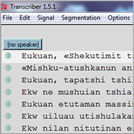
The transcription files are then loaded into Toolbox. This is a software program developed by the Summer Institute of Linguistics (SIL), which allows editing text, aligning linguistic analysis with audio data and creating a lexicon of the language. Below is an illustration of Toolbox.
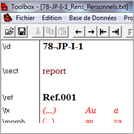
The first line of the analysis is the transcription of the audio data (\tx). The transcription must reflect as faithfully as possible what is actually said on the recording, including pauses, errors, repeats, and all other prosodic information. It is also recommended to transcribe what is unintelligible (or inaudible), indicating an x for each inaudible or unintelligible syllable, rather than trying to guess what is being said. The transcription is in standardized orthography but it reflects the dialectal variety of Pessamit. The second line presents the division of words into morphemes (\morph), followed by a “phonetic” line (\phonP). This stage requires that the smallest units of meaning (phonemes) have previously been established. This division (into morphemes and phonemes) is linked to the following lines, where the glosses are found (\gl.FR for French glosses and \gl.EN for English glosses), since it determines all the units to be glossed. There exist a number of glossing conventions which should be followed, for example the Leipzig Glossing Rules. The two last lines are the French (\tr.FR) and English (\tr.EN) translations. Note that after each segment is found the reference to the audio file (\wav), followed by the time units of the corresponding audio segment. This allows playing the audio file of each segment in the Toolbox program.